Independent data search identifies records of protected bats, badgers, otters and breeding great crested newts on and around Site A — despite the application’s ecological desk study reporting “no records” for those species groups
BICESTER, Oxfordshire – A Bicester resident has uncovered what she says are serious gaps in the ecological evidence submitted in support of the Home Office’s proposed asylum accommodation centre at MOD Bicester Site A, after obtaining local wildlife records that were apparently absent from the application’s Preliminary Ecological Appraisal.
Claire Brenner, a Bicester resident and local campaigner, began investigating after reading the Preliminary Ecological Appraisal (PEA) submitted with the application (Cherwell District Council ref: 26/01833/CROWN).
“The assessment said there were no records for otter, bats, badger or great crested newt within 2km of the site,” said Brenner. “I found that impossible to believe, given that I have seen rare wildlife there myself. So I started digging.”
The PEA does not identify the Thames Valley Environmental Records Centre (TVERC) – the Local Environmental Records Centre for Oxfordshire — as a source for its background data search. Instead, it identifies the Buckinghamshire and Milton Keynes Environmental Records Centre (BMERC) and an open-access national database.
Professional guidance published by the Chartered Institute of Ecology and Environmental Management (CIEEM) states that sources used for a development background data search must include the relevant Local Environmental Records Centre where one exists.
TVERC describes itself as the Local Environmental Records Centre covering Oxfordshire and Berkshire and recommends that ecology reports submitted with planning applications in those counties include a search of its data.
Brenner subsequently obtained data from TVERC and analysed the records against the proposed development boundary.
Her findings include:
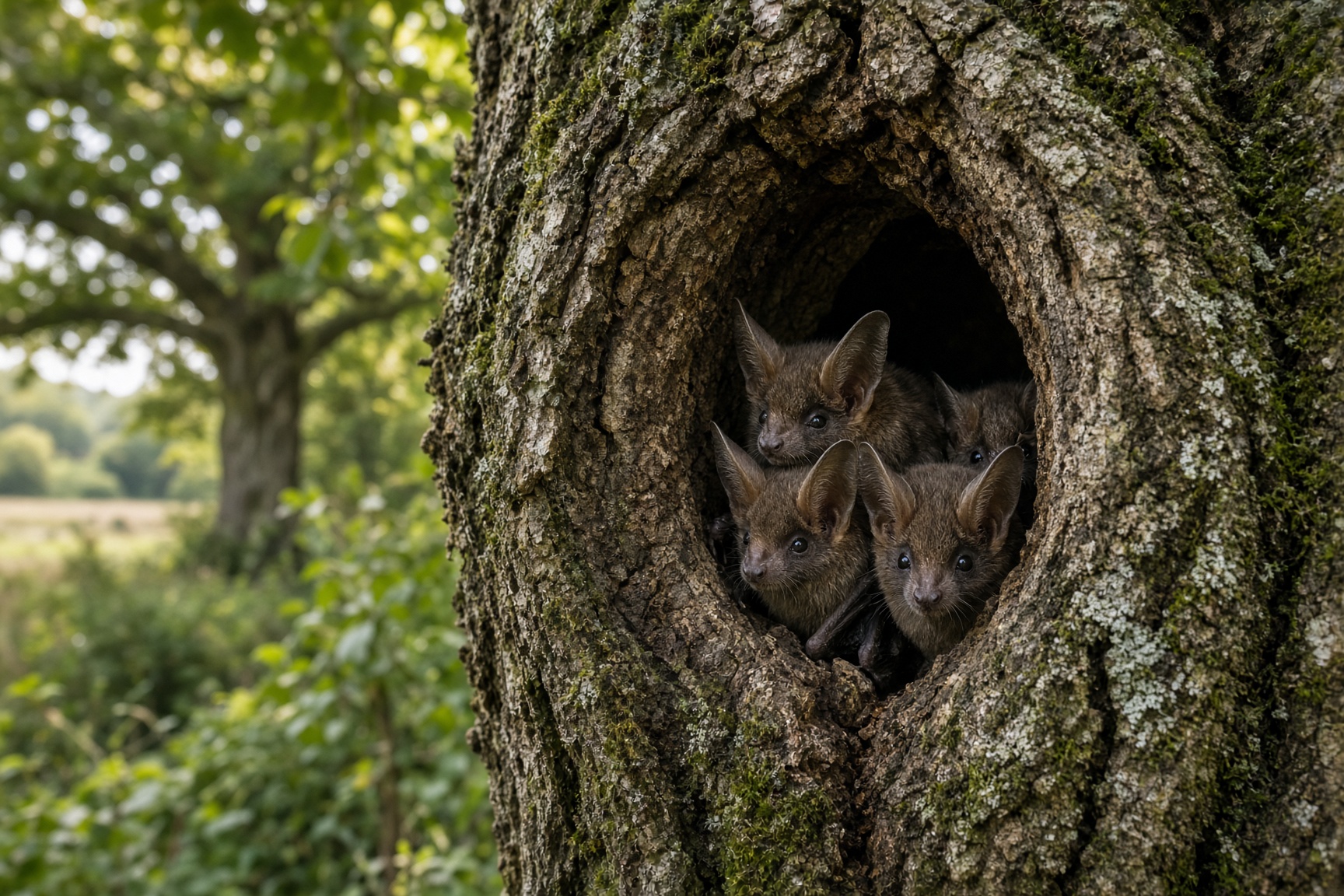
- 12 protected bat species recorded within 2km of the site, several within 1km: Barbastelle, Bechstein’s bat, Brandt’s bat, Brown long-eared bat, Common pipistrelle, Daubenton’s bat, Eurasian serotine, Leisler’s bat, Nathusius’s pipistrelle, Natterer’s bat, Noctule and Soprano pipistrelle — including a confidential record of the rare Bechstein’s bat within the search area.
- An otter recorded close to the MOD boundary, with Brenner’s analysis placing the record approximately 366 metres from the application site in 2021.
- Records of breeding great crested newts, including a 2019 record associated with the application site and a breeding cluster, including juveniles, approximately 350 metres away.
- Badger records approximately 300 metres from the site.
- Nightingale recorded on MOD Bicester land in 2020 and again in 2024. Breeding nightingale had previously been absent from Oxfordshire for decades before habitat management work at MOD Bicester helped the species breed in the county again.
- 188 records relating to rare and protected wildflowers across 29 species, including Devil’s-bit Scabious, a species included within dedicated recovery work in Oxfordshire.
- 66 bird species identified in the local records, compared with 25 reported in the assessment, including 27 species on the UK conservation Red List.
“This isn’t a minor oversight,” Brenner said. “It’s the difference between a report that says there are no records for these species groups and local data showing a landscape containing numerous records of protected and notable wildlife.
“Decisions on land this important shouldn’t be made on a desk study that appears not to have consulted the relevant local records centre.”
Questions over the records used
The Buckinghamshire and Milton Keynes Environmental Records Centre does not cover Oxfordshire as its principal geographic area, while TVERC is the Local Environmental Records Centre covering Oxfordshire.
Brenner’s analysis also found that the great majority of the ecological search area – including Site A itself – falls within the area covered by TVERC.
The significance of the issue is not that the existence of a historic wildlife record automatically proves that a species is currently present at a particular point on the site.
Rather, background ecological records are used to help establish what species and habitats may be present, identify potential ecological constraints and inform what further survey work may be required.
CIEEM guidance on biodiversity data states that a comprehensive desk study should be undertaken at the outset when ecological surveys are intended to inform a development proposal, and that the relevant Local Environmental Records Centre should form part of that process.
TVERC similarly advises that ecology reports submitted with planning applications in Oxfordshire should include a search of its data.
The records identified by Brenner therefore raise questions over whether the ecological baseline used for the MOD Bicester application gives decision-makers a sufficiently complete picture of the wildlife previously recorded on and around the site.
Urgent Crown Development application
The Home Office application proposes temporary use of MOD Bicester Site A for non-detained asylum accommodation for up to 1,256 service users.
It is being considered through the Government’s Urgent Crown Development procedure, under which the application is made directly to the Secretary of State rather than being determined by Cherwell District Council.
The current public representation period runs from 7 September to 17 September 2026.
Brenner has submitted a formal objection setting out her findings and is calling for the ecological evidence to be reviewed and, where necessary, corrected before a decision is made.
“This is being fast-tracked with less scrutiny than an ordinary planning application,” she said. “That makes it more important, not less, that the evidence behind it is right.”
Brenner has shared her findings with Calum Miller, MP for Bicester and Woodstock, and with the Wrong Plan Wrong Site campaign.
Why does the records search matter?
Local Environmental Records Centres collect and maintain detailed information about wildlife, protected and notable species, habitats and local wildlife sites within their areas.
CIEEM’s professional guidance explains that background ecological data is important in development proposals because it can identify potential constraints, inform survey design and provide evidence about protected or priority species that may require further investigation.
Its guidance states that the sources consulted for a development background data search must include the relevant Local Environmental Records Centre where one exists.
For Oxfordshire, that body is TVERC.
“Different records centres hold different local data – protected species records, priority habitats and Local Wildlife Sites – that simply isn’t duplicated everywhere else,” Brenner said.
“If you don’t search the relevant local records, you risk starting the assessment without the full picture. With an application of this scale, that matters.”
Data acknowledgement: The wildlife findings referred to in this article are based on biodiversity data supplied by Thames Valley Environmental Records Centre (TVERC) and analysed by Claire Brenner. The underlying TVERC report and raw records are subject to TVERC’s data-use and publication conditions.