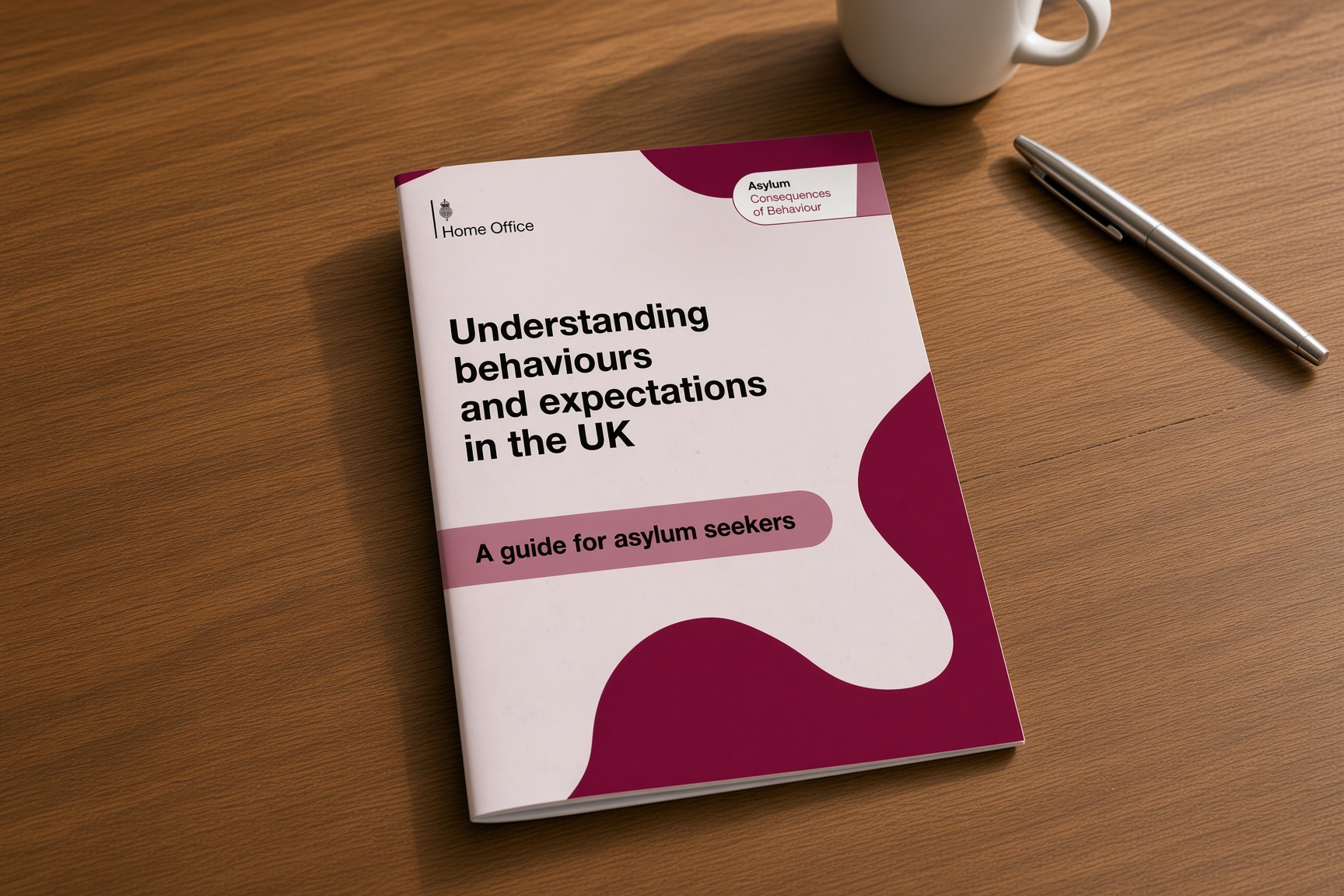
The Home Office has produced a guide for asylum seekers titled Understanding behaviours and expectations in the UK.
The booklet explains that people seeking asylum may come from countries where laws and customs are different from those in the UK, and sets out expectations around gender equality, domestic abuse, sexual consent and behaviour in public.
Read the Home Office leaflet here
For Wrong Plan. Wrong Site., the existence of this guidance raises an important question about MOD Bicester Site A: how have the safeguarding, equality and community-safety issues addressed by the Home Office itself been assessed in relation to a proposal to accommodate around 1,250 single adult men at this location?
Safeguarding must be part of the decision
The Home Office booklet covers issues including equal rights for women, controlling behaviour, domestic abuse, consent, the legal age of consent, sexual offences and behaviour in public spaces.
WPWS believes local communities are entitled to understand how these considerations have been assessed specifically for Site A.
That includes questions around the safety and freedom of women and girls, safeguarding of children and vulnerable people, policing requirements, public transport, rural walking routes, lighting, reporting mechanisms and the ability of local services to respond effectively if concerns arise.
These issues should neither be exaggerated nor dismissed. They should be properly assessed, planned for and supported by evidence.
Different backgrounds require proper planning
The Home Office itself acknowledges that laws and customs in the UK may differ from those in an asylum seeker’s home country.
Bringing around 1,250 single adult men from a range of different cultural and social backgrounds into a rural area is a major change for both those being accommodated and the surrounding communities.
That does not mean assuming that individuals will behave unlawfully.
It does mean that integration, community cohesion, safeguarding and public confidence should be considered properly before a decision is made.
WPWS believes the Government should explain what practical measures would be in place to communicate UK laws and expectations, support integration, protect vulnerable people and maintain confidence within nearby communities.
Women and girls should be able to live as they do today
The Home Office guidance states clearly that women in the UK have equal rights, can travel freely, make their own decisions and must not be controlled in where they go or what they do.
Women and girls living around Site A should be able to continue walking, running, using public transport, travelling independently and using local public spaces with confidence.
The question for Government is straightforward:
Has it properly assessed how a development of this scale could affect the safety, perceived safety and freedom of women and girls in surrounding communities – and what measures would be put in place if concerns are identified?
What WPWS wants published
Before Site A proceeds, WPWS believes the Government should publish:
- its site-specific safeguarding and community-safety assessment;
- its equality impact assessment;
- its assessment of the implications for women and girls;
- proposed policing and incident-reporting arrangements;
- plans for lighting, pedestrian routes and public transport;
- arrangements for communicating UK laws and behavioural expectations to residents;
- and details of how safeguards would be monitored once the site is operating.
This is about responsible planning
WPWS remains focused on the suitability of MOD Bicester Site A and the evidence behind the Government’s decision-making.
The Home Office guidance does not prove that individuals proposed to be accommodated at Site A present a particular risk. But it does show that the Government itself considers gender equality, consent, domestic abuse and public behaviour important enough to address directly with people seeking asylum.
WPWS believes those same issues must form part of a transparent, site-specific safeguarding assessment before any final decision is made.
Publish the evidence. Demonstrate the safeguards. Prove it before you proceed.